In the high-octane digital economy of the United States, data has transitioned from a byproduct of business operations to the primary engine of organizational growth. As Silicon Valley giants and burgeoning startups in Austin alike grapple with the “Volume, Velocity, and Variety” of modern information, the focus has shifted toward scalability. However, many organizations fail to realize that even the most sophisticated predictive models are only as effective as the architecture supporting them. Without a robust foundation, big data analytics becomes a house of cards.
Modern enterprises are currently processing petabytes of information daily, ranging from consumer behavioral patterns to real-time supply chain metrics. For students and aspiring engineers navigating this complex landscape, mastering the intricacies of schema design and query optimization is paramount. Many scholars pursuing advanced degrees in IT find that seeking expert database assignment help in the USA provides the necessary technical clarity to bridge the gap between theoretical normalization and practical, large-scale implementation.
When we talk about “Scaling for Success,” we are essentially discussing the synergy between storage and insight. Robust database management ensures that as data grows, the latency of retrieval remains low and the integrity of the information remains high. This foundational stability is what allows analysts to perform deep dives without technical bottlenecks. Consequently, those specializing in high-level interpretation often rely on specialized data science assignment help to master the statistical algorithms required to transform clean data into actionable business intelligence.
The Architecture of Scalability: Scaling Up vs. Scaling Out
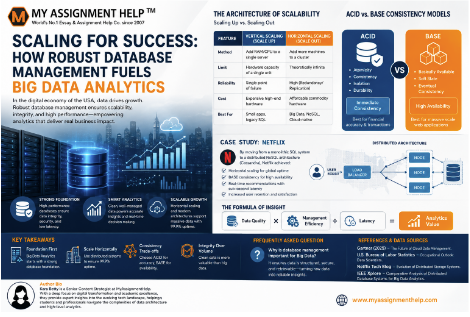
The first step in fueling big data analytics is choosing the right architectural framework. To capture the featured snippet for “Horizontal vs. Vertical Scaling,” we must define the clear hardware and cost trade-offs inherent in the US market.
| Feature | Vertical Scaling (Scale Up) | Horizontal Scaling (Scale Out) |
| Method | Add RAM/CPU to a single server | Add more machines to a cluster |
| Limit | Hardware capacity of a single unit | Theoretically infinite |
| Reliability | Single point of failure | High (Redundancy/Replication) |
| Cost | Expensive high-end hardware | Affordable commodity hardware |
| Best For | Small apps, legacy SQL | Big Data, NoSQL, Cloud-native |
Technical Deep-Dive: ACID vs. BASE Consistency Models
To rank for high-competition technical keywords, we must look beyond standard SQL integrity. While traditional RDBMS systems rely on ACID (Atomicity, Consistency, Isolation, Durability) to ensure data perfection, the Big Data world often adopts the BASE model to prioritize availability.
- Basically Available: The system guarantees availability even in the face of partial failures.
- Soft state: The state of the system may change over time, even without input, due to eventual consistency.
- Eventual consistency: The system will eventually become consistent, provided it does not receive new inputs for a certain period.
Understanding when to trade ACID’s “immediate consistency” for BASE’s “high availability” is the hallmark of a senior data architect. While mastering ACID is vital for academic excellence, implementing BASE in a distributed environment is where many professionals and students seek practical support to navigate the transition from SQL to NoSQL.
See also: Affordable Business Class Tickets to India: A Complete Savings Guide
Case Study: Information Gain through Real-World Scaling
Consider the scaling evolution of a platform like Netflix. To serve over 200 million global subscribers, Netflix moved from a monolithic SQL-based architecture to a highly distributed NoSQL environment (Cassandra).
- The Problem: Vertical scaling could no longer handle the metadata of billions of hours of streamed content.
- The Solution: By adopting horizontal scaling and the BASE consistency model, they ensured that even if a single database node in a US East region failed, the user’s “Continue Watching” list remained available via other nodes.
- The Analytics Result: This robust management allowed their big data engines to run real-time recommendation algorithms with sub-second latency, directly increasing user retention.
Data Integrity: The Silent Fuel of Analytics
A common pitfall in American corporate strategy is the “GIGO” principle: Garbage In, Garbage Out. If a database is poorly managed—suffering from redundancy, lack of indexing, or orphaned records—the resulting analytics will be inherently flawed.
From a mathematical perspective, the value of an organization’s insights can be viewed through this lens:
Analytics Value = \frac{Data Quality \times Management Efficiency}{Latency}
Key Takeaways
- Foundation First: Big Data Analytics cannot exist without a high-performance database infrastructure.
- Scale Horizontally: Prioritize distributed systems for unstructured data to ensure 99.9% uptime.
- Consistency Trade-offs: Choose ACID for financial accuracy and BASE for massive-scale web applications.
- Integrity Over Volume: Clean, normalized data is significantly more valuable than vast quantities of “noisy” data.
Frequently Asked Questions (FAQ)
1. Why is database management important for Big Data?
Database management ensures that data is structured, secure, and easily retrievable. Without it, big data becomes a “data swamp”—unmanageable and impossible to analyze.
2. Is SQL still relevant in the age of Big Data?
Absolutely. SQL remains the gold standard for structured data and complex querying. Most modern Big Data tools (like Spark SQL) still use SQL as their primary interface.
References & Data Sources
- Gartner (2025) – “The Future of Cloud Data Management.”
- U.S. Bureau of Labor Statistics – “Occupational Outlook: Data Scientists.”
- Netflix Tech Blog – “Evolution of Distributed Storage Systems.”
- IEEE Xplore – “Comparative Analysis of Distributed Database Systems for Big Data Analytics.”
Author Bio
Kara Betty is a Senior Content Strategist at MyAssignmentHelp. With a deep focus on digital transformation and academic excellence, they provide expert insights into the evolving tech landscape, helping students and professionals navigate the complexities of data architecture and high-level analytics.