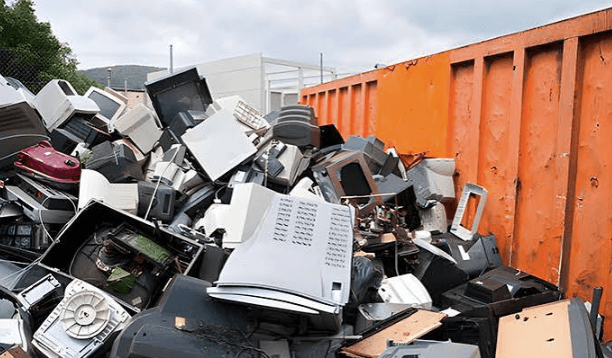
Local recycling searches work reasonably well for one broken toaster and badly for a storeroom holding forty retired workstations. The results tell you where to drive, not how to move volume, protect data or produce a record for your finance team. Choosing between a depot drop-off, a scheduled pickup and a mail-in label is the decision that actually determines how painful the clear-out becomes.
Start With Volume, Then Sensitivity
Two variables drive the choice, and taking them in the right order saves time.
Volume decides the logistics. Sensitivity decides the safeguards. A single old printer needs neither a truck nor a certificate. Forty machines that ran your finance system need both.
Get those two answers down before you contact anyone and the conversation becomes short and specific.
Option One: The Depot Drop-Off
Best for small quantities, low sensitivity and situations where you would rather not schedule anything.
The Electronic Recycling Association operates depots in cities including Vancouver, Calgary, Edmonton, Saskatoon, Winnipeg, Toronto, Ottawa, Montreal and Halifax. You bring the items, you hand them over, you leave.
The trade-off is documentation and effort. If you need serial-level records or you would be making four trips in a hatchback, this is the wrong tool.
Option Two: The Scheduled Pickup
Best for anything that fills more than a car boot, and for anything data-bearing.
ERA dispatches trucks to offices, businesses and homes across Canada, and there is a meaningful distinction between the two service levels. A straightforward pickup suits bulk equipment with nothing sensitive on it. An advanced pickup is the one to request when you need serial number reporting, secure data destruction or detailed documentation.
This is also where data handling can be arranged as part of the same job rather than as a separate project. Drives can be wiped with multi-pass software, or physically destroyed using AmeriShred mobile shredders either at ERA’s facility or at yours.
When to Insist on On-Site Destruction
Bring the shredder to you when your security policy says data-bearing hardware must not leave the building intact, when a compliance officer needs to witness destruction personally, or when the data class makes transit risk unacceptable regardless of how good the provider is.
For organisations with the strictest rules, ERA also rents out mobile AmeriShred units. A representative delivers the machine and trains your cleared staff, and your own team does the shredding. Custody never transfers at all.
Option Three: The Shipping Label
Best when geography, not volume, is the obstacle.
ERA runs a shipping label programme for people and small offices too far from a depot to make a trip sensible. It is the quiet answer to “there is nothing near us,” which is otherwise the most common reason equipment stays in a cupboard indefinitely.
See also: SEO Performance 912919152 With Technical Audit
The Question Nobody Asks Early Enough
Before choosing a route, find out what the provider will actually do with the equipment.
ERA’s process runs in four stages: collection, data destruction, refurbishment by technicians and volunteers, then donation to community organisations. Eligible recipients include registered charities, non-profits, care facilities such as seniors’ homes and hospitals, and educational institutions.
That matters commercially as well as ethically. Equipment donated onward can generate a Donation in Kind Certificate, which your finance team may care about more than your IT team does.
What About Cost
For most standard donations and pickups there is no fee, because the programme is funded through a mix of refurbished equipment sales, partnerships and donations.
Larger operations do sometimes carry costs, specifically those needing detailed reporting, physical destruction or unusual logistics. Ask for that to be outlined up front rather than discovering it on an invoice. Any provider worth using will give you a straight answer before the truck is booked.
A Practical Sequence
- Count the items and note which held data.
- Decide what documentation you need — inventory spreadsheet, wipe certificate, certificate of destruction, or all three.
- Match volume to route: depot for small, pickup for bulk, shipping label for remote.
- Specify on-site destruction if policy requires it.
- Reconcile the returned inventory against your asset register while the project is still fresh.
Getting the Clear-Out Right
Local recycling searches answer a question about geography when a business clear-out is really a question about volume, data and paperwork. Sort those three first and the right collection method becomes obvious rather than a guess. Get the count and the documentation list ready, then have one conversation with a provider that can handle collection, destruction and donation as a single job.